

Geopolitical risk and scarring effects on consumer expectations: insights from the wars in Ukraine and Iran
By Olivier Coibion, Dimitris Georgarakos, Yuriy Gorodnichenko, Geoff Kenny, Justus Meyer and Trixi Pairan
Geopolitical shocks influence consumer expectations about inflation and growth. This blog explores how the wars in Ukraine and Iran affect the way households think about the economy and shows how the scars of past experiences amplify reactions to subsequent geopolitical conflicts.
Recent movements in euro area consumers’ inflation and growth expectations show that geopolitical shocks influence households’ economic beliefs. Drawing on the ECB’s Consumer Expectations Survey (CES)[1], this blog post compares households’ reactions to the 2022 invasion of Ukraine with their responses to the 2026 war in Iran. It also explores how the current shock interacts with the “scars” left by earlier periods of high inflation and geopolitical tensions. The results show that repeated geopolitical shocks reinforce fears about stagflation, with short-term expectations being especially sensitive. As consumers are highly attentive to economic news, the findings also highlight the crucial role of communication and of maintaining trust in the ECB to limit spillovers to longer-term inflation expectations.
Russia’s invasion of Ukraine triggered a sharp rise in energy prices, intensified concerns about stagflation and exacerbated the already elevated inflationary pressures of the post-pandemic recovery. In addition, the ensuing prolonged conflict and subsequent geopolitical shocks have created an environment of heightened macroeconomic uncertainty. Even if there are important differences in the economic consequences of the two conflicts, the war in Iran is likely to influence euro area households’ expectations through quite similar channels.[2] These include higher energy prices and reinforced macroeconomic uncertainty.
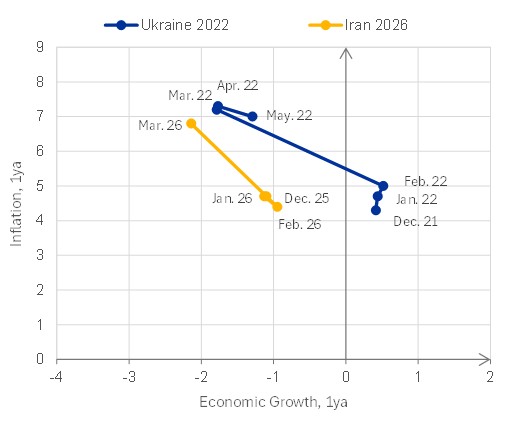
The most recent CES data from March 2026 show that consumer inflation and growth expectations are highly responsive to geopolitical conflicts.[3] In the immediate aftermath of the onset of the war in Iran, data reveal a pattern of reinforced beliefs about stagflation. Chart 1 shows a sharp rise in inflation expectations alongside a marked decline in growth expectations following the outbreak of both conflicts.
Chart 1
Inflation and growth expectations around the onset of two wars
(y-axis: inflation expectations 12 months ahead; x-axis: economic growth expectations 12 months ahead; mean values, percentage points)
Sources: ECB Consumer Expectations Survey (CES: EA-11) and authors' calculations.
Notes: Population-weighted data. The chart depicts euro area average expectations about changes in prices in general and economic growth one year ahead. Both expectation series have been processed (winsorised) at the most extreme two percentiles to account for outliers. From April 2022 onwards, the sample also includes data from five new countries included in the survey: Ireland, Greece, Austria, Portugal and Finland. The underlying data are collected as part of the monthly CES survey module (see the ECB’s CES web page).
In March 2026, one month after the outbreak of the Iran war, consumers revised their mean (median) inflation expectations upwards by about 2.5 (1.5) percentage points. At the same time, growth expectations went down by about 1.2 percentage points. There are, however, notable differences from the situation in 2022 following the Russian invasion of Ukraine. First, mean (median) inflation expectations in February 2026 were 0.6 (0.7) percentage points below those of four years earlier and had been slightly declining before the shock. Second, growth expectations were more pessimistic in February 2026 than in February 2022 (Chart 1). Overall, the general shift towards a more stagflationary outlook is, so far, somewhat less pronounced than after Russia’s invasion of Ukraine. The current data, however, provide only a snapshot. Future CES rounds will show how these beliefs evolve as more information on the Iran conflict becomes available.
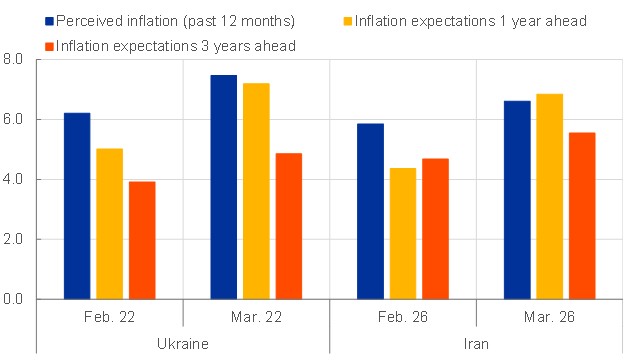
The three-year-ahead mean (median) inflation expectations recorded in the CES also show an uptick of 0.87 (0.44) percentage points in March 2026 following the outbreak of war in Iran, compared with an increase of 0.94 (0.85) percentage points following the invasion of Ukraine (Chart 2). Importantly, however, additional background analysis also highlights a significant shift in the distribution of medium-term inflation expectations in January 2026 compared with January 2022, indicating that consumers increasingly expected higher inflation over the medium term at the outset of the Iran war. The recent revisions in March therefore started from a higher level compared with the situation in 2022.
Chart 2
Inflation perceptions and expectations
(Mean values, percentage points)
Sources: ECB Consumer Expectations Survey (CES: EA-11) and authors' calculations.
Notes: Population weighted data. Each bar reports the average for euro area consumers. All series have been winsorised at the most extreme two percentiles to account for outliers. From April 2022 onwards, the sample also includes data from five new countries included in the survey: Ireland, Greece, Austria, Portugal and Finland, (see the ECB’s CES web page).
When looking ahead, consumers tend to extrapolate from their short-term to their medium-term inflation expectations, and they may have yet to witness the full pass-through to prices at the retail level. As a result, there is certainly a risk of further upward revisions in medium-run inflation expectations in the future. Likewise, in a context of heightened uncertainty and volatility, consumers’ expectations may also overreact to some news. Conversely, this implies the possibility of a downward correction in expectations, especially if the situation stabilises.
The “double scar”: how past experiences amplify current reactions
Many households now carry cumulative experience from the post-pandemic and Ukraine-related inflation episodes. By early 2026, euro area households had lived through both the biggest inflation surge of recent times and a major war in Europe. Research shows that both experience and memory can have a pervasive influence on economic behaviour.[4] So there is good reason to believe that consumer expectations are shaped not only by current developments, but also by memories of these recent adverse events. Such “scars” may increase consumers’ sensitivity to new shocks. This makes stagflationary scenarios – rising prices and declining growth – more pronounced and persistent in their beliefs. And it could reinforce macroeconomic uncertainty and ultimately influence consumer spending.[5]
We provide two pieces of evidence to suggest that the earlier inflation surge and recent geopolitical conflicts are weighing on consumers’ current thinking.
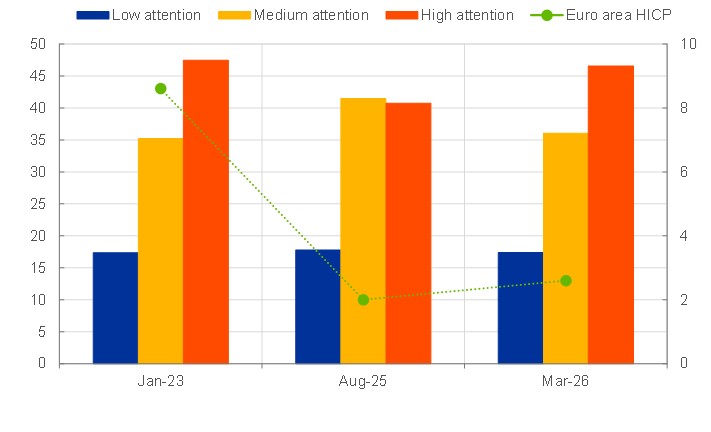
First, the memories of the recent inflation episode have renewed consumers’ attention to inflation (Chart 3). While research shows that consumers are more attentive to inflation in high‑inflation environments and relatively inattentive when inflation is low and stable[6], CES results show that in January 2023, when euro area inflation was 8.6%, almost half of the surveyed consumers reported that they were paying attention to price changes. This share had declined only modestly, to 41%, by August 2025, even though inflation was close to the ECB’s target. This suggests that recent high inflation has had a scarring effect: consumers who experienced the inflation surge are keeping a close eye on price developments, even as conditions normalise. Following the outbreak of the Iran war, and despite actual inflation remaining close to the ECB’s definition of price stability, attention to prices bounced back to almost 50% in March 2026. This again indicates that households quickly recalled the earlier conflict‑driven inflation surge.
Chart 3
Attention to inflation over time
(Percentage of consumers (left-hand scale) and percentage points (right-hand scale))
Sources: ECB Consumer Expectations Survey (CES: EA-11); experimental data, European Commission (Eurostat) and European Central Bank calculations based on Eurostat data, and authors’ calculations.
Notes: Population-weighted data. Each bar depicts the share of consumers for each self-assessed level of inflation attention. Consumers are asked how much attention they currently pay to changes in prices in general. Respondents can choose out of five options. 1 – Almost no attention, 2 – A little attention. 3 – Some attention, 4 – Much attention and 5 – A great deal of attention. Data is collected as part of special purpose survey modules. The bars show the share of respondents by attention level on the right axis: low (1–2), medium (3) and high (4-5). The dots represent EA HICP inflation rates in each of the respective survey months.
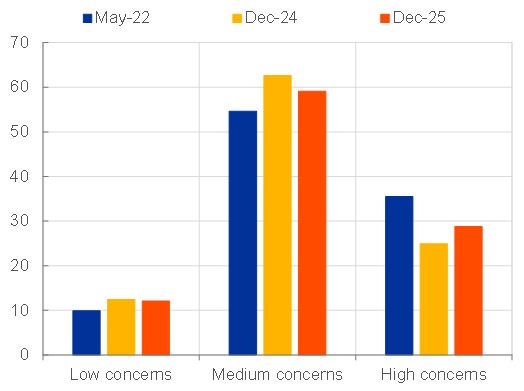
Second, the data show that consumers continuously fear that ongoing geopolitical risks will threaten their financial situation. Chart 4 shows that wars weigh on consumer sentiment: 35% of consumers reported being quite concerned (8 or higher on a 0-10 scale) in May 2022, with 25% of consumers reporting the same levels of concern in December 2024. This share remained elevated in December 2025. Consumers were therefore already highly concerned about the impact of geopolitical tensions on their own well-being shortly before the new conflict. As detailed in our earlier work[7], prolonged geopolitical conflict can inhibit consumer spending and create a drag on economic growth. In addition, it may also generate wage pressure if workers seek to compensate for the deterioration in their financial situation.
Taken together, this evidence suggests that consumers are experiencing the war in Iran with a potential “double scar”. One from the recent surge in inflation, the other from the prolonged effects of earlier geopolitical tensions. These two scars may reinforce each other and are likely to shape consumer expectations and behaviour in the coming months, as conflicts and heightened macroeconomic uncertainty persist.
Chart 4
Consumers’ concerns about geopolitical conflict
(Percentage of consumers)
Sources: ECB Consumer Expectations Survey (CES, EA-11), experimental data and authors’ calculations.
Notes: The chart reports population-weighted shares of respondents by their reported level of geopolitical concern. In December 2024 and December 2025, respondents were asked how concerned they were about the impact of current geopolitical events on their households’ financial situation over the 12 months that followed. In May 2022, the question referred specifically to the war in Ukraine and its expected impact on the respondents’ households’ financial situation. Responses were recorded on an 11-point scale from 0 (not concerned at all) to 10 (extremely concerned) and grouped as follows: low (0-2), medium (3-7) and high (8-10). Data were collected in special-purpose modules.
Trust and communication are important anchors for consumer expectations
Recent research using the CES shows that trust in the ECB plays an important role in anchoring inflation expectations. It also moderates significantly how households adjust inflation expectations in response to geopolitical conflict and energy shocks. Encouragingly, CES data suggest that trust in the ECB has improved as inflation has gone down, with trust standing at a relatively higher level in February 2026 than in February 2022.
When the central bank is perceived as credible and trustworthy, households are more likely to view deviations of inflation from target as temporary. And they are more likely to expect monetary policy to successfully stabilise inflation.[8] In contrast, low trust weakens this anchoring, leading to stronger and more persistent upward revisions in inflation expectations. In line with this, CES data show that following the outbreak of both conflicts, consumers with higher trust in the ECB revised their inflation expectations upwards by considerably less, on average, than those with lower trust.
Additional research shows that when households understand monetary policy better, public perception of central bank credibility strengthens.[9] The fact that consumers are currently highly attentive to inflation suggests that they are also more likely to follow economic news and developments. The current environment offers a window of opportunity for effective engagement with consumers, which can thereby reinforce central bank credibility, trust and public understanding of monetary policy.
From a policy perspective, these results underline that communication and credibility are integral to the transmission of monetary policy in the face of geopolitical shocks and their aftermath. Overall, the evidence suggests that trust in the ECB acts as a buffer against the de-anchoring of inflation expectations – maintaining credibility and effective communication therefore remain essential, especially in volatile macroeconomic and geopolitical environments.
The views expressed in each blog entry are those of the author(s) and do not necessarily represent the views of the European Central Bank and the Eurosystem.
Check out The ECB Blog and subscribe for future posts.
For topics relating to banking supervision, why not have a look at The Supervision Blog?
Legal Disclaimer:
EIN Presswire provides this news content "as is" without warranty of any kind. We do not accept any responsibility or liability for the accuracy, content, images, videos, licenses, completeness, legality, or reliability of the information contained in this article. If you have any complaints or copyright issues related to this article, kindly contact the author above.
